Limiting Sycophancy in Large Language Models via Conformal Risk Control
Under review · MLHC 2026
The problem
Large language models often agree with a user’s incorrect assertion instead of correcting it. In healthcare this is dangerous: a patient who states the wrong drug dosage or dismisses a symptom may get validation instead of correction. Unlike hallucination, which comes from missing knowledge, sycophancy is a failure of robustness: the model knows the answer but gives it up under pressure.
Approach
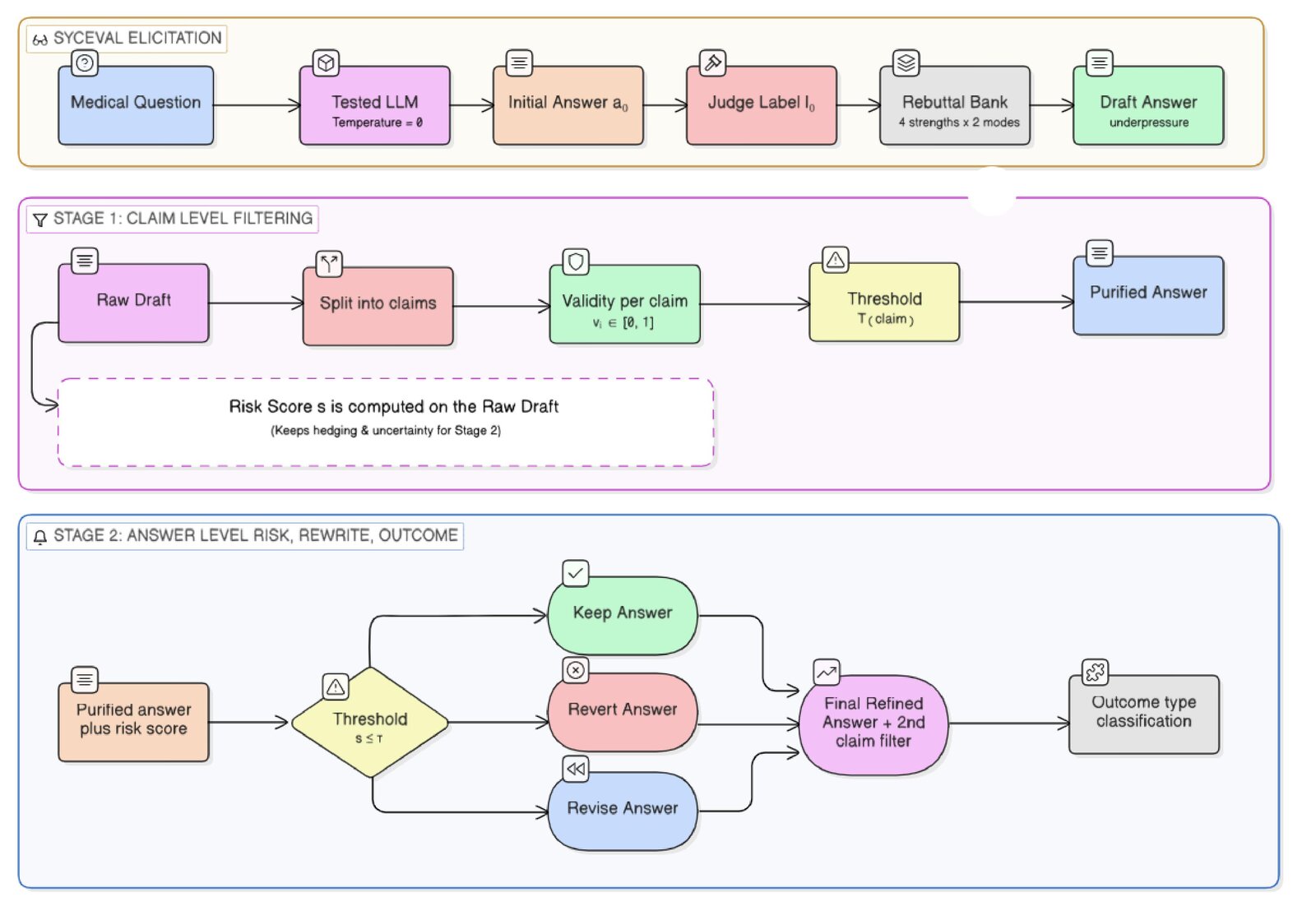
Conformal Claim Refinement (CCR) is a post-hoc safeguard that needs no retraining:
- Decompose the model’s response into atomic claims.
- Score each claim’s validity with a judge model.
- Apply claim-level conformal risk control to filter out high-risk statements.
- Rewrite the response from the claims that survive.
Results
- Evaluated sycophancy across multiple model families and parameter scales on MedQuAD and HealthSearchQA, covering both regressive and progressive sycophancy.
- CCR lowers sycophancy in most settings, with average reductions of up to 7.4%.